

Rees vs. Gannon & LaFleur
How Atlanta’s Coaching Staff Completely Outschemed Green Bay in a 35 to 14 Statement Win
On a Thursday night in Green Bay, the Atlanta Falcons did more than simply win a football game. They delivered a masterclass in coaching execution, schematic clarity, and in game dominance. The final score read 35 to 14, but the underlying numbers and film told an even clearer story: one staff imposed its will on both sides of the ball while the other struggled to find answers.
This was not an upset born of luck or individual heroics alone. It was the product of superior preparation and adaptability, particularly from Atlanta offensive coordinator Tommy Rees, against a Green Bay coaching staff that entered the contest with higher individual and collective grades on paper.
Setting the Stage
Michael Penix Jr. made his long awaited 2026 season debut after recovering from a torn ACL suffered in Week 11 of the previous year. The Falcons sat at 0 wins and 2 losses, their offense sputtering through the first two weeks. Penix’s return injected both talent and urgency into a unit that desperately needed a spark.
Pregame CoachingAI metrics painted an interesting picture. Tommy Rees carried a D+ grade and 69.5 rating. Across from him, Packers defensive coordinator Jonathan Gannon held a C grade and 73.9 rating. At the team level, Green Bay’s overall coaching staff graded out significantly higher (C minus, 70.31) than Atlanta’s (F, 56.17). On paper, the advantage belonged to the home side. On the field, the opposite proved true.
Atlanta’s Offensive Masterclass Under Tommy Rees
Rees and the Falcons offense controlled the game from the opening series. The final statistical ledger was emphatic:
- 498 total yards
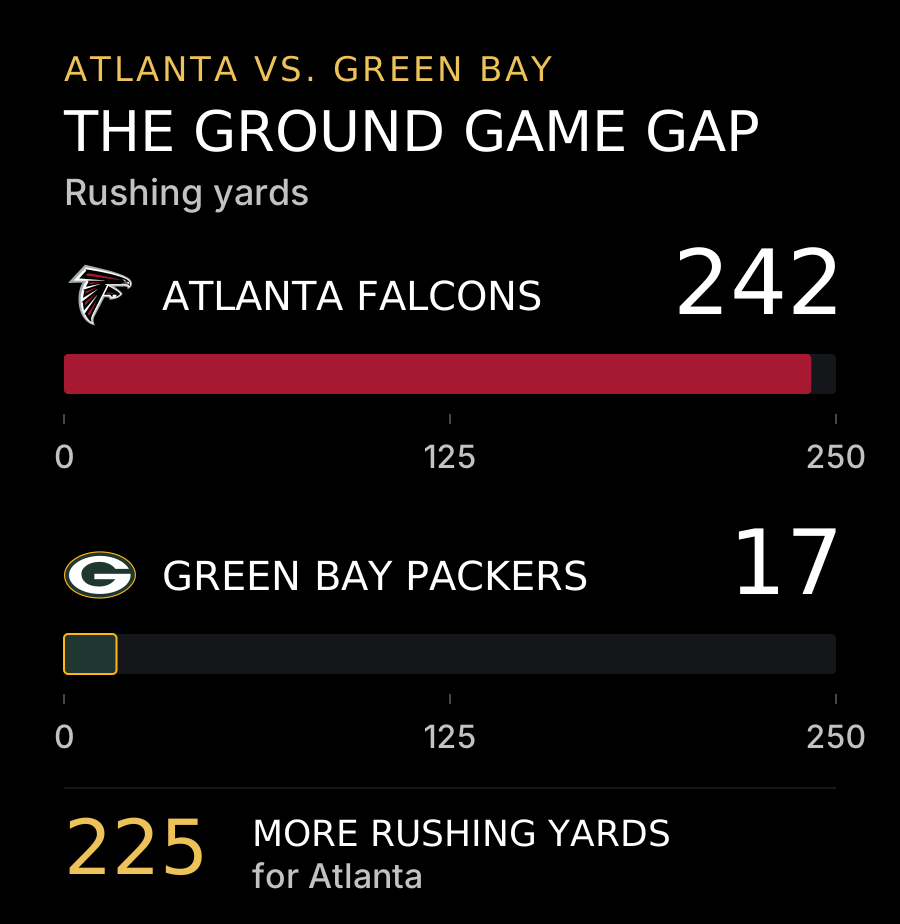
- 242 rushing yards
- 7.5 yards per play
- 25 first downs
- Zero sacks allowed
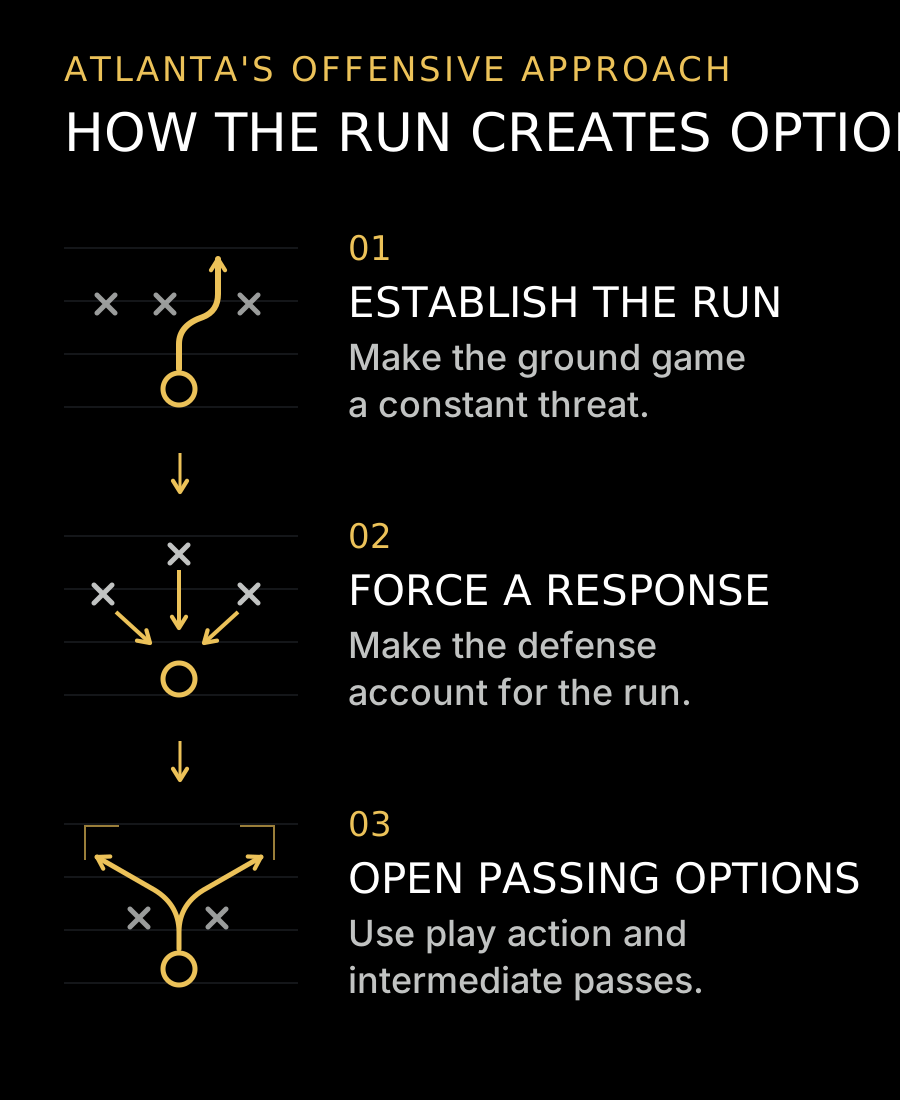
Bijan Robinson was the clear centerpiece, carrying 29 times for 194 yards. The commitment to the run was not situational or reactive, it was foundational. Rees established the ground game early, stayed patient with it, and forced Green Bay to defend the entire width and depth of the field.
Penix, in his first action in more than ten months, operated efficiently within the structure. He completed 18 of 25 passes for 256 yards and a touchdown. More importantly, he was clean in the pocket and decisive with the football. The offensive line provided excellent protection, and the play calling kept the Packers’ defense off balance.
What stood out most was the balance and physicality. Atlanta did not abandon the run when it worked, nor did it become predictable when Green Bay loaded the box. Rees mixed concepts effectively, used motion and alignment variation, and consistently put his skill players in advantageous positions. The result was sustained drives and a defense that spent most of the evening on its heels.
Green Bay’s Defensive Struggles Under Jonathan Gannon
Jonathan Gannon entered the game with the higher individual rating, yet his track record as a defensive coordinator has long been viewed as checkered and inconsistent. During his tenure with the Philadelphia Eagles (2021 to 2022), the defense showed improvement and reached the Super Bowl in 2022. However, that success came with significant outside help. Vic Fangio served as a consultant during that period, including formal short term assistance around the playoffs and Super Bowl preparation. Gannon’s scheme borrowed heavily from Fangio’s two high, match quarters concepts, and many observers have noted that Fangio’s input was a meaningful factor in the unit’s performance. The reliance on Fangio has led to ongoing questions about how much of the Eagles’ defensive success was driven by Gannon’s own schematic vision versus external expertise.
After leaving Philadelphia, Gannon’s three seasons as Arizona Cardinals head coach produced a record of 15 wins and 36 losses, further reinforcing perceptions of inconsistency. His early results in Green Bay, including this heavy run game failure against Atlanta, have added to that mixed evaluation.
On this night, Gannon’s unit had no consistent answer for Atlanta’s approach. The Packers allowed 242 rushing yards and 7.5 yards per play. They failed to generate meaningful negative plays against the run and rarely forced the Falcons into obvious passing situations. Once Atlanta established the ground game, Green Bay’s defensive front and second level defenders struggled to fit gaps and finish tackles.
Schematically, the Packers appeared reactive rather than proactive. Adjustments were slow to materialize, and the defense never dictated terms. Even when the Falcons worked in play action or intermediate concepts, the underlying run threat continued to stress Green Bay’s structure. The final score reflected a defensive performance that could not rise to the moment, and one that fit into the broader pattern of uneven results throughout Gannon’s coordinator career.
Green Bay’s Offensive Ineffectiveness Under Matt LaFleur
While the defensive shortcomings were glaring, the Packers’ offense under head coach and primary play caller Matt LaFleur offered little resistance of its own.
Green Bay managed just 328 total yards and 14 points. The most damning number was the rushing total: 17 yards. Without a credible ground game, the offense became one dimensional. Jordan Love threw for 312 yards and two touchdowns on 28 of 53 passing, but the lack of balance allowed Atlanta to focus its coverage and pressure packages on the pass.
Third down efficiency sat at 6 of 15. The Packers punted five times and never consistently sustained drives. Protection was relatively clean (only one sack), yet the unit still lacked rhythm and explosiveness. LaFleur’s group failed to impose any physical identity and never forced the Falcons’ defense into difficult choices.
In a game defined by Atlanta’s ability to run the football, Green Bay’s inability to do the same proved decisive.
What the Game Revealed About Coaching Adaptability
This matchup offered a clear illustration of the difference between pregame metrics and in game problem solving. CoachingAI grades provide valuable historical and positional context, Rees’ strong marks as a quarterbacks coach and offensive coordinator, Gannon’s mixed defensive coordinator numbers, and LaFleur’s established track record. Those numbers, however, do not capture the ability to adjust in real time.
Atlanta’s staff identified a path to success, committed to it, and refined it throughout the evening. Green Bay’s staff, on both sides of the ball, struggled to counter. The Falcons dictated personnel, tempo, and preferred line of scrimmage outcomes. The Packers spent most of the night responding.
High level coaching is not solely about the quality of the initial plan. It is about the capacity to evolve that plan when the opponent presents new challenges. On this night, one staff demonstrated that capacity more effectively than the other.
Conclusion
The Falcons’ 35 to 14 victory was a statement win built on superior coaching execution. Tommy Rees designed and called an offense that controlled the line of scrimmage and maximized the return of Michael Penix Jr. Jonathan Gannon’s defense, already carrying questions about schematic independence from his Eagles tenure, could not solve the run game. Matt LaFleur’s offense never found balance or rhythm.
Pregame CoachingAI data suggested Green Bay held the edge in overall staff grading and individual defensive coordinator rating. The final result demonstrated that grades are a starting point, not a guarantee. On field adaptability, commitment to identity, and in game problem solving still decide outcomes.
For those who value deeper insight into coaching performance, positional trends, and historical context, platforms like CoachingAI offer the data that helps separate narrative from measurable reality. The film from Green Bay provided a vivid reminder of why that distinction matters.
Lead Beyond Limits.
Objective sports intelligence for NFL coaching decisions.
