Football's Hiring Problem Isn't a Talent Problem.
It's an Evaluation Problem.

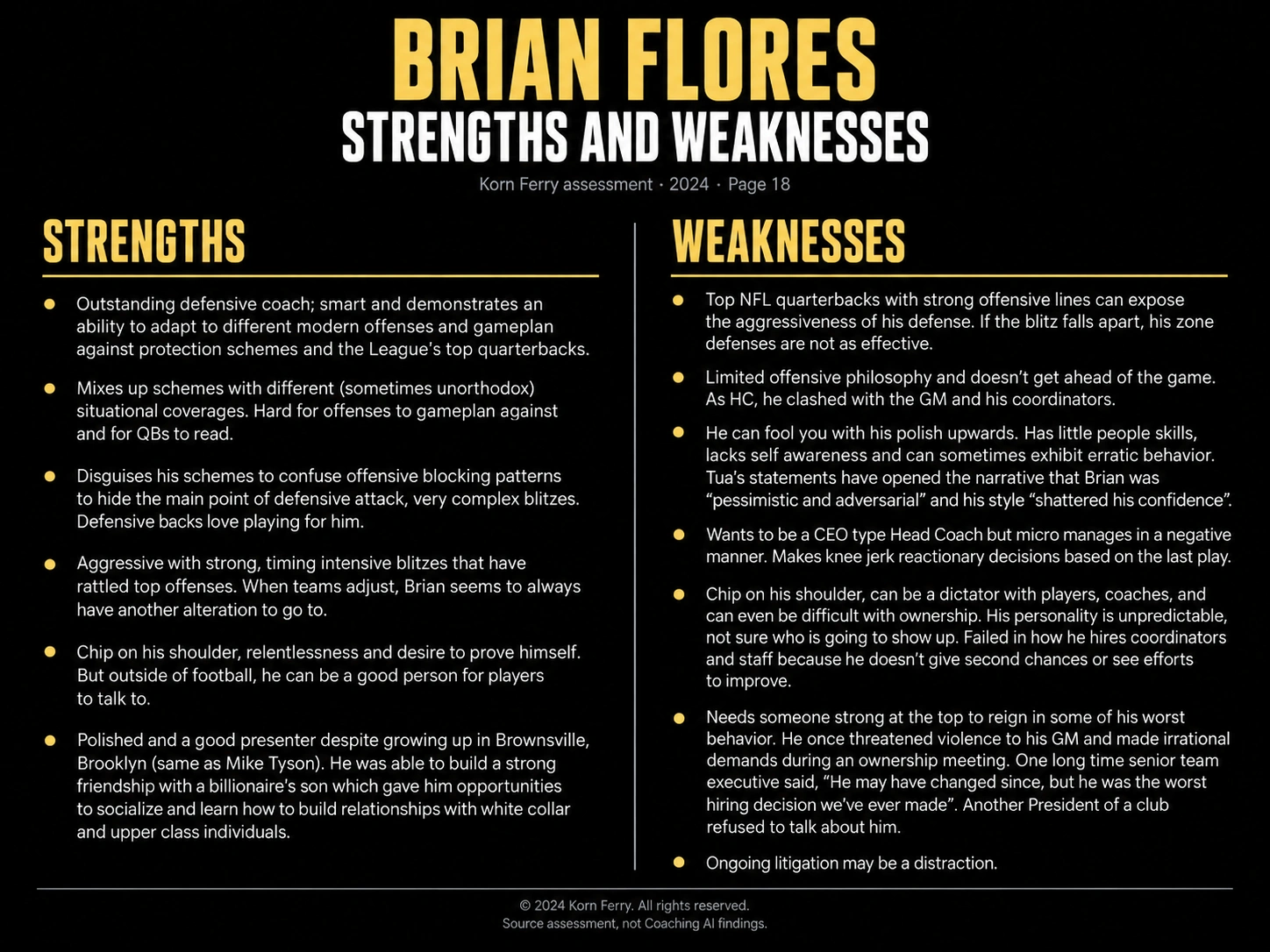
The recently unsealed report on Brian Flores has sparked debate across football about bias, leadership, and how coaching candidates are evaluated. But the bigger issue extends well beyond one coach or one search.
It raises a simple question:
Why do NFL teams and college football programs spend millions evaluating players with sophisticated analytics, yet continue to evaluate coaches largely through interviews, references, and personal opinions?
Modern football measures everything. Teams track player movement, game efficiency, recruiting success, injury risk, and countless performance metrics. Yet when it comes to hiring the people responsible for leading entire organizations, the process often comes down to subjective assessments such as "culture fit," "leadership presence," or whether someone interviewed well.
The problem is obvious. One decision maker sees confidence, another sees arrogance. One sees accountability, another sees confrontation. The same behavior can generate completely different conclusions depending on who's conducting the interview.
That challenge exists at both the NFL and college levels, where coaching searches increasingly involve multimillion dollar contracts and carry enormous consequences for franchises and athletic departments.
A more effective approach is to combine traditional evaluations with objective measurement tools.
The Coaching Performance Assessment System (CPAS) is one example. Instead of relying primarily on reputation or perception, CPAS evaluates measurable factors such as coaching experience, positions coached, level of competition, player development, postseason success, championship experience, staff development, and career progression.
CPAS also delivers a three layer coaching intelligence profile. The first provides an objective background and performance grade. The second analyzes in game decision making through Weekly In Season Reports. The third tracks coaching effectiveness and position group performance throughout the season, creating a more complete picture of how a coach actually performs.
But performance metrics tell only part of the story.
Leadership and communication remain essential components of coaching success. Research led by Dr. Steven Randolph Cureton at the University of North Carolina at Greensboro found that while common indicators of coaching success exist across football, they are often applied inconsistently during hiring evaluations. That research led to the development of the Sociological Qualitative Assessment Instrument (SQAI), a speech analysis tool designed to assess leadership ability, teaching effectiveness, coaching strategy, communication style, and vocal tone using standardized criteria.
Together, CPAS and SQAI address both sides of the evaluation equation.
CPAS measures results. SQAI evaluates leadership and communication.
The combination creates a more balanced hiring process by reducing reliance on narratives, personal impressions, and interviewer bias.
The Flores memo attracted attention because it provided a rare look behind the curtain. Regardless of one's opinion of Flores, the document highlighted how heavily football still relies on subjective evaluations when making some of its most important decisions.
For a sport that embraces analytics everywhere else, that approach increasingly feels outdated.
The future of coaching searches should not be driven solely by interviews, references, or reputation. NFL teams and college programs should demand the same level of rigor in evaluating coaches that they already demand when evaluating players.
In a business where one hiring decision can shape the future of a franchise or university for years, evidence should carry more weight than perception. And the organizations that figure that out first may gain the next competitive advantage in football.
Lead Beyond Limits.
Objective sports intelligence for NFL coaching decisions.
More from Coaching AI
Coaching Carousel Heat Rises
Why Better Evaluation Tools Matter for Beamer, Locksley, and Every Program
3 min read
Rees vs. Gannon & LaFleur
How Atlanta’s Coaching Staff Completely Outschemed Green Bay in a 35 to 14 Statement Win
6 min read